AI Chatbot with Personality: How to Build a Bot Your Customers Actually Want to Talk To
Most customers can tell when they're talking to a bot. Adding personality to your AI chatbot transforms the experience from boring and robotic into something authentic — an extension of your brand.

Why Your AI Chatbot Needs a Personality
Most customers can tell when they're talking to a bot. The flat, robotic responses. The generic "I'm sorry, I didn't understand that." The complete absence of warmth. And the moment they feel it — that cold, impersonal wall — they leave.
Here's the truth: a chatbot with no personality is a missed opportunity. Your AI chatbot is often the first point of contact a visitor has with your brand. It runs 24/7, handles hundreds of conversations simultaneously, and shapes the customer experience before a human ever gets involved. If it sounds like a machine reading from a manual, you're actively eroding the brand you've worked so hard to build.
Adding personality to your AI chatbot changes everything. It transforms the chatbot experience from boring and robotic into something that actually feels authentic — an extension of who you are as a brand. Done right, a chatbot's personality can drive engagement and retention, create an emotional connection with your audience, and make your customer support bot a genuine competitive advantage.
So what does it actually mean to give an AI chatbot a personality? And how do you build one that matches your brand? Let's get into it.
What Is a Chatbot Personality?
A chatbot personality is the set of human traits, communication patterns, and behavioral characteristics that define how your bot interacts with users. It's not just tone of voice — it's everything from how formal or casual the language is, to whether the bot uses humor, to how long its answers are, to whether it throws in a 😊 or keeps things strictly professional.
Think of it this way: chatbot persona is an extension of your brand identity into every single automated conversation. It's how you make a chatbot feel less like a search engine and more like a knowledgeable, likable team member who happens to never sleep.
A strong bot personality covers:
- Tone of voice — formal, conversational, playful, authoritative
- Language style — simple and friendly vs. expert and precise
- Emoji usage — heavy, light, or none at all
- Humor level — dry wit, warm banter, strictly professional
- Answer length — short and snappy or long and detailed
- Name and identity — does your bot have a name that fits your brand?
Getting these right means your AI chatbot starts to feel natural — like it genuinely belongs to your brand rather than being bolted on as an afterthought.
The Five Chatbot Personality Types (and Which One Fits Your Brand)
When developing a chatbot, one of the first decisions is figuring out what kind of personality it should have. There's no single right answer — it depends entirely on your brand, your target audience, and the kind of customer experience you want to create.
Here are five core chatbot personalities to consider. Think of them as starting points — in practice, most great AI chatbots blend elements of two or three.
1. The Friendly Helper 🤝
Best for: Lifestyle brands, beauty, home goods, pet products, wellness
The Friendly Helper is warm, approachable, and genuinely enthusiastic about helping. It uses informal language, greets customers by name where possible, and never makes someone feel stupid for asking a question. It might use a few emojis to keep things light, and its answers are conversational — never overwhelming.
This personality type prioritizes making the customer feel comfortable and supported. It's the digital equivalent of a helpful shop assistant who actually seems happy to be there.
Example interaction style:
"Hey! Great choice — that one's a bestseller 😊 Want me to help you find the right size?"
If your brand voice is built around community, inclusion, and warmth, the Friendly Helper is your match. With Flyweight, you can set your chatbot's advanced personality to lean into informal language and moderate emoji usage to nail this persona exactly.
2. The Expert Advisor 🔍
Best for: Technical products, B2B, software, electronics, professional services
The Expert Advisor is knowledgeable, precise, and efficient. It uses a more formal tone, avoids unnecessary filler, and gets straight to the point. Customers come to it because they trust it knows its stuff — and it delivers every time.
This personality doesn't need humor or emojis. It builds trust through competence. Its answers may be longer and more detailed because precision matters more than brevity. Think of it as the conversational AI equivalent of the most knowledgeable person in your industry — available 24/7.
Example interaction style:
"The ACME enterprise plan supports role-based access control and integrates with LDAP/SSO authentication. Would you like a full feature comparison?"
Formal language, detailed answers, minimal personality flourishes — the Expert Advisor is about substance over style. Flyweight allows you to configure this precisely: formal language mode, long and detailed answers, and an advanced personality prompt that positions the bot as a domain expert.
3. The Playful Entertainer 🎉
Best for: Toys, games, entertainment, youth brands, novelty products, events
The Playful Entertainer is the most expressive chatbot persona on this list. It uses many emojis, injects humor into nearly every interaction, and treats each conversation as a chance to delight the customer. This bot doesn't just answer questions — it creates a micro-experience.
This personality is high-risk, high-reward. When it matches the brand perfectly, it creates an emotional connection that turns first-time visitors into loyal fans. When it doesn't match, it feels forced and off-putting. The key is brand alignment.
Example interaction style:
"Oh, you've found our BEST product 🎮🔥 Honestly? Great taste. Want me to tell you why everyone's obsessed with it? (Spoiler: it's very good.)"
Flyweight's speaking style settings were practically built for this persona — crank emoji usage to maximum, set humor to "be very humorous," and use informal language throughout.
4. The Premium Concierge 🎩
Best for: Luxury goods, high-end fashion, premium hospitality, jewelry, bespoke services
The Premium Concierge is sophisticated, attentive, and understated. It never oversells. It doesn't use slang or emojis. Every response is carefully crafted to reinforce the sense that the customer is receiving exceptional, personalized attention.
This is one of the more nuanced chatbot personalities to develop, because the goal isn't warmth — it's elegance. The Premium Concierge treats every interaction like a white-glove service call. It anticipates needs, provides thoughtful recommendations, and never rushes.
Example interaction style:
"Of course. The Noir Collection is available in three finishes — allow me to walk you through each one and suggest the option that best complements your requirements."
For this persona, Flyweight's formal language mode is essential. Avoid emojis entirely, set answer length to detailed, and use the advanced personality field to define the tone precisely — think "luxury hotel front desk" rather than "helpful friend."
5. The Relatable Conversationalist 💬
Best for: Direct-to-consumer brands, food & beverage, sustainable products, culture-driven brands
The Relatable Conversationalist sounds like a real person — not a brand spokesperson, not a robot, not a customer service script. It's the bot that uses light humor naturally, speaks the same language as your customers, and isn't afraid to acknowledge when something's out of stock with a casual "ugh, I know — sorry about that 😬."
This persona works best when the brand itself has a strong, defined personality that customers identify with. It requires more careful calibration than the Friendly Helper — it needs to feel genuine, not performative.
Example interaction style:
"Honestly, that's one of our most popular items and it keeps selling out faster than we can restock it. Let me check what's actually available right now."
Use informal language, light humor, and a small number of emojis for this persona. The advanced personality in Flyweight is where you define the brand voice — drop in a few lines that capture how your brand talks, and the chatbot will mirror it.
How Flyweight Automatically Detects Your Brand's Personality
One of the most powerful things about Flyweight's AI chatbot for Shopify is that it doesn't start from zero. When you install Flyweight, it loads all of your store's public content — product descriptions, FAQs, policies, pages — into a dedicated knowledge graph built specifically for your brand.
From that content, Flyweight automatically detects your brand's personality. It reads the general style your brand already uses in its writing and uses that as the baseline for the chatbot's behavior. If your product descriptions are punchy and casual, the bot will start that way. If your store copy is polished and professional, that's what gets reflected back.
This matters because it means you don't have to build a chatbot persona from scratch. Flyweight gives you a smart starting point derived directly from your existing brand identity — and then gives you full control to refine it.
Customizing Your AI Chatbot's Personality in Flyweight
Once Flyweight has detected your baseline personality, the real fun begins. The app's personality settings let you take that foundation and shape it into exactly the chatbot persona your brand needs.
Name Your Bot
The first step in developing a chatbot with genuine identity is giving it a name. In Flyweight's settings, you can set a name that the assistant uses when asked — a small detail that makes a significant difference to how customers perceive the interaction. A named bot feels like a character. An unnamed bot feels like a utility.
Set the Advanced Personality
This is where your chatbot's personality takes full shape. Flyweight gives you up to 5,000 characters to define how the bot sees itself and behaves. You can go broad ("You are a knowledgeable, friendly assistant who loves helping customers find the perfect product") or highly specific ("You are Max, a witty assistant for a premium streetwear brand who uses casual language, light sarcasm, and the occasional 🔥 — but never at the expense of being helpful").
Almost anything is possible here. This field is where you encode tone of voice, specific behavioral rules, what topics to prioritize, and the overall character of the bot.
Fine-Tune the Speaking Style
Beyond the personality prompt, Flyweight offers granular controls over speaking style:
- Language formality: Choose between formal language (think "Sie/Ihre" in German) or informal, polite language ("Du/Deine") — a distinction that matters enormously for customer experience in many markets.
- Answer length: Set responses to be short and concise or long and detailed, depending on what your customers need.
- Emoji usage: Avoid emojis entirely, use a few for warmth, or go all-in for a playful brand voice.
- Humor level: From "avoid humor" for premium or professional brands, through "use light humor" for approachable brands, to "be very humorous" for entertainment-forward brands.
These controls work in combination with your advanced personality prompt, giving you a layered system that's both easy to use and remarkably precise.
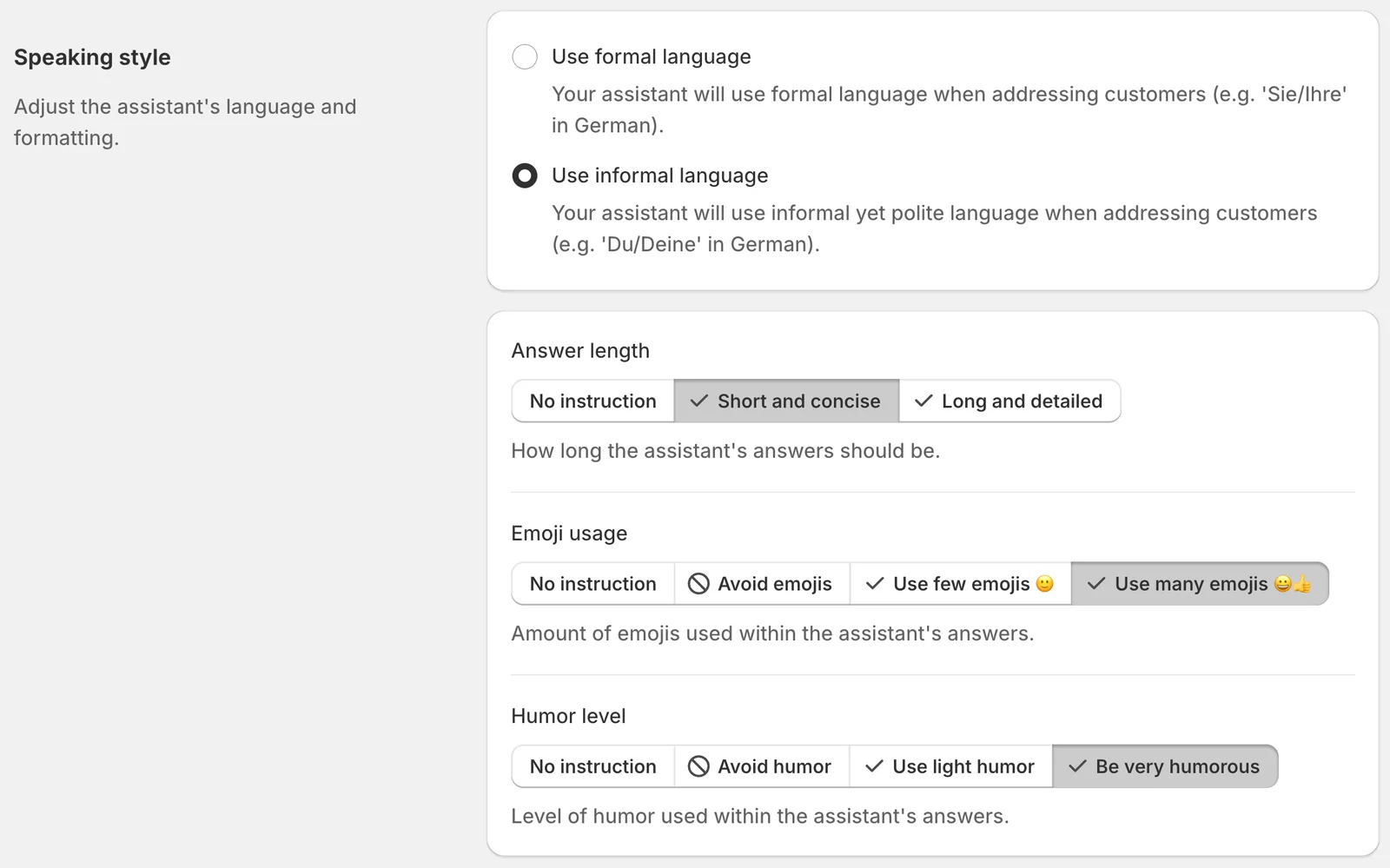
Merchants can fine-tune their AI assistant’s personality inside the Flyweight AI Shopify app.
How to Keep Your Chatbot's Personality Consistent
Building the personality is step one. Keeping it consistent over time is where many brands slip up. Here are the key principles:
Anchor the personality to your brand guidelines. If you have a tone of voice document, your chatbot personality should reflect it. Use language from your existing guidelines when writing the advanced personality prompt.
Test before you launch. Flyweight includes a preview function that lets you test the chatbot before it goes live. Use it. Send the kinds of questions your customers actually ask — including the awkward ones — and check that the personality holds up under pressure.
Review with user feedback. Real conversations reveal things testing misses. Review chatbot transcripts regularly and look for moments where the personality slips — responses that feel off-brand, too stiff, too casual, or simply wrong in tone. Use that feedback to refine your advanced personality prompt.
Update when your brand evolves. Brand identity changes over time — new campaigns, new products, new audiences. Make sure your chatbot's personality keeps pace with those changes. Regular updates to the personality settings keep the bot feeling current and on-brand.
Why Personality Makes the Difference on Shopify
For Shopify store owners specifically, an AI chatbot with a strong personality isn't a luxury — it's a practical business tool. Here's why:
It reduces abandonment. A conversational AI that engages customers warmly keeps them on the page longer and gives them the nudge they need to complete a purchase.
It scales your brand voice. Your chatbot handles thousands of interactions. If it has a consistent, on-brand personality, every one of those touchpoints reinforces your brand image — at zero marginal cost.
It improves the customer experience. Customers who get fast, helpful, pleasantly-toned responses are more likely to return. Personality makes interactions feel worth having.
It sets you apart. Most Shopify stores are using generic AI tools. A chatbot with a genuine, distinctive persona is a rare thing — and customers notice.
Build Your AI Chatbot with Personality Using Flyweight
Flyweight is the shopify AI chatbot platform built specifically for Shopify that takes personalization seriously. From automatic brand personality detection to granular speaking style controls, it gives you everything you need to create an AI chatbot that truly represents who you are.
Whether your brand is a luxury concierge, a playful entertainer, an expert advisor, or a relatable conversationalist — Flyweight lets you build that chatbot without writing a single line of code.
Transform the chatbot experience from boring and robotic into something your customers actually enjoy. Give your AI the personality your brand deserves.

 Ice Barrel
 STAY SPICED !
 Australian Bodycare
 Pullup & Dip
 Venen Engel
 VEYNOU